


Asia: The Rapidly Rising Global Education Powerhouse
Rapidly advancing in Innovation, Growth, Opportunity.



Study in Japan
Average Annual Tuition Fees
Weekly Part-Time Work
Post-Study HSFP Visa

Finland at a Glance
-
Japan’s national universities charge some of the lowest tuition fees in the developed world for the calibre of institution on offer. The University of Tokyo, Kyoto University and Osaka University each rank in the global top 30 by QS, operate billion-dollar research budgets and maintain direct partnerships with Toyota, Sony, Hitachi, Fujitsu, Mitsubishi and NTT. These are not industry collaborations in name only, students study in Japan and also work on live commercial research from within their degree.
-
The MEXT (Monbukagakusho) Scholarship, administered by the Japanese Government, is one of the most comprehensive government-funded awards available to international students globally. It covers full tuition at any national university, a monthly living stipend of JPY 117,000 to 145,000, return international airfare and accommodation support. It is open at undergraduate, master’s and doctoral levels.
-
Japan has produced 29 Nobel Prize laureates in Physics, Chemistry and Medicine with 18 of those awarded since the year 2000. Its output in materials science, quantum computing, robotics and precision manufacturing is cited more per capita in top-tier academic journals than almost any nation outside the United States. Students Study in Japan and graduate into an economy built on technological mastery.
-
Japan’s post-study structure is among the most clearly defined in Asia. The Highly Skilled Foreign Professional (HSFP) visa awards points across academic qualifications, annual income and age graduates from nationally ranked universities enter with a strong base score. 70+ points qualify for PR in 3 years. 80+ points qualify for PR in 1 year. Japan is actively incentivising skilled international graduates to remain long-term.


 University of Tokyo
 Kyoto University
 Osaka University
 Tokyo Institute of Technology
 Tohoku University
Study in South Korea
Average Annual Tuition Fees
Weekly Part-Time Work
D-10 Job Search Visa
South Korea at a Glance
-
Study in South Korea that has been ranked the world’s most innovative country by Bloomberg’s Innovation Index for eight of the last ten years. The economy is anchored by Samsung Electronics, SK Hynix, LG Energy Solution, Hyundai and POSCO companies that operate global supply chains and recruit directly from Korean university campuses, particularly in semiconductor engineering, battery technology, AI and materials science.
-
The Korean Government Scholarship Programme (GKS/KGSP) is fully funded and available to students from over 120 countries. It covers tuition fees in full, provides a monthly living stipend of KRW 900,000 (approximately USD 680), includes one year of Korean language training before the degree begins, settlement allowance, health insurance and return airfare. It is one of the most structured government scholarship programmes in the world.
-
KAIST the Korea Advanced Institute of Science and Technology, ranks in the global top 20 for engineering and technology by QS and operates entirely in English for international students. South Korea’s semiconductor industry alone accounts for 20% of the country’s total exports, the highest sector concentration of any major economy and universities feed directly into it through government-mandated industry-university research clusters.
-
South Korea’s Points-Based Immigration System (KIIP + F-series visa pathway) allows foreign graduates who secure qualifying employment to accumulate residency points through salary level, Korean language proficiency, age and employment duration. Graduates from top Korean institutions with employment in strategic sectors can reach Permanent Residency eligibility in 3 to 5 years. The F-2 Resident Visa issued during this period allows full work rights and family inclusion.


 Seoul National University
 KAIST
KAIST
 Yonsei University
 Korea University
 Sungkyunkwan University
Study in Singapore
Average Annual Tuition Fees
Weekly Part-Time Work
LOC Post-Study Pass
Singapore at a Glance
-
The National University of Singapore ranks #8 globally and Nanyang Technological University ranks #15 in the 2025 QS World University Rankings making Singapore the only city-state on earth with two universities in the global top 20. Both institutions maintain research partnerships with Goldman Sachs, Google DeepMind, Alibaba, Procter & Gamble and over 400 corporate partners across finance, technology, biomedical and engineering sectors.
-
Singapore’s Ministry of Education Tuition Grant subsidises up to 90% of international student tuition fees at NUS, NTU, SMU and SUTD in exchange for a three-year post-graduation work commitment in Singapore a structure that functions as both a scholarship and a direct employment pipeline. It is one of the most practical financial instruments available to any international student, anywhere. Study in Singapore and avail best education for your life.
-
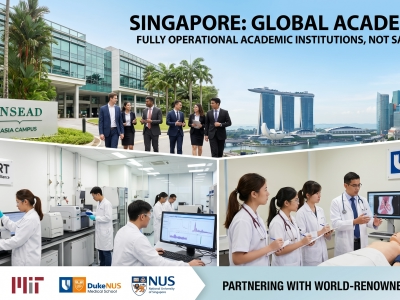
Singapore operates branch and full campuses of some of the world’s most recognised institutions. INSEAD ranked among the top 3 business schools globally runs its full Asia campus here. The Singapore-MIT Alliance for Research and Technology (SMART) embeds MIT-level research directly into Singapore’s university ecosystem. Duke-NUS Medical School delivers a US-model medical degree jointly with National University of Singapore. These are not satellite offices they are fully operational academic institutions.
-
Permanent Residency in Singapore is achievable through the Employment Pass to PR pathway. EP holders who have worked in Singapore for two or more years in a qualifying professional role are eligible to apply for PR. NUS and NTU graduates entering through the LOC post-study scheme consistently report among the highest EP approval rates of any international graduate group, given Singapore’s declared priority to retain STEM and finance talent.
 National University of Singapore
 Nanyang Technological University
 Singapore Management University
 SUTD
SUTD
 Singapore Institute of Technology
Study In Malaysia
Average Annual Tuition Fees
Weekly Part-Time Work
Long-Stay Option
Malaysia at a Glance
-
Malaysia is the only country in Southeast Asia where students can earn a fully accredited degree from a British, Australian or American university on campus, in Malaysia, at 40 to 60% of the cost of studying at the home institution. Monash University Malaysia, University of Nottingham Malaysia, Heriot-Watt University Malaysia, Newcastle University Medicine Malaysia and Curtin University Malaysia each deliver home-country qualifications. The degree awarded is identical to the one earned in Melbourne, Nottingham or Perth. Study in Malaysia and earn a British, Australian or American master’s or bachelor’s degree with Edualliance’s support and Guidance.
-
The Malaysia International Scholarship (MIS) is a fully funded government award for international postgraduate students. It covers full tuition, a monthly stipend, accommodation allowance, travel grant and health insurance. Administered by the Ministry of Higher Education, it targets candidates in science, technology, engineering and sustainability fields directly aligned to Malaysia’s national industrial development agenda.
-
Malaysia’s Penang corridor is the world’s sixth-largest electronics export hub, with Intel, AMD, Infineon Technologies, Texas Instruments, Bosch and Osram all operating large-scale chip assembly, testing and R&D facilities in the state. Engineering and electronics graduates from Malaysian universities, including those from Universiti Teknologi Malaysia and branch campuses, are recruited directly into these facilities, frequently before graduation.
-
Malaysia’s My Second Home (MM2H) programme and the skilled worker Employment Pass provide structured long-term stay options for graduates who enter employment. The cost of living in Kuala Lumpur is approximately one-third of Singapore and one-quarter of Tokyo, while offering the same access to globally branded degrees, English-language instruction and a genuinely international student community. For the value-to-qualification ratio, no destination in Asia comes close.

 Universiti Malaya
 Universiti Putra Malaysia
 Universiti Teknologi Malaysia
 Monash University Malaysia
 University of Nottingham Malaysia